Why HDPE & PP Spiral Tanks Are Replacing Metal Tanks in Chemical Industries
Chemical industries operate in extremely aggressive environments. Acids, alkalis, salts, solvents, and high-temperature fluids constantly attack storage equipment. For decades, mild steel and stainless steel tanks were the default solution for chemical storage.
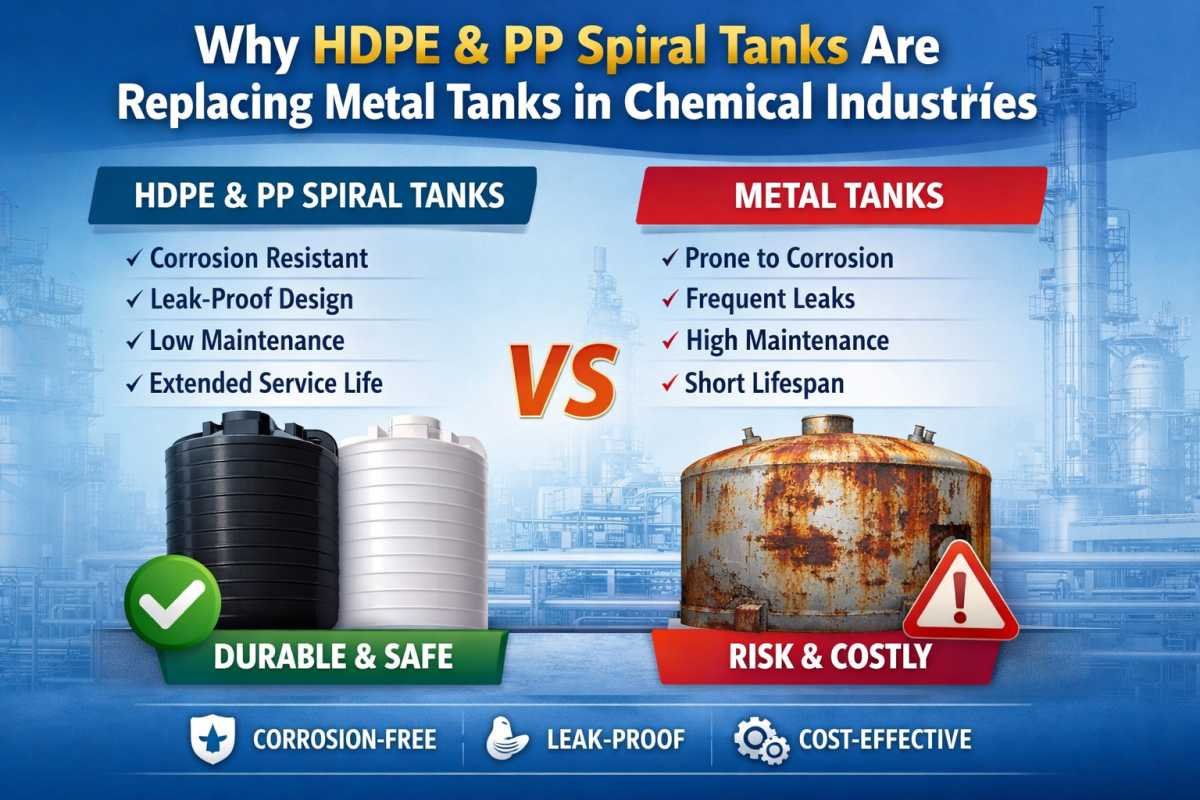
However, industries today are rapidly shifting toward HDPE Spiral Tanks and PP Spiral Tanks due to corrosion problems, maintenance costs, and safety risks associated with metal tanks. Modern thermoplastic engineering now provides safer, longer-lasting, and more economical alternatives.
This transition is not a trend — it is a technological upgrade in industrial storage systems.
Understanding HDPE & PP Spiral Tanks
HDPE (High Density Polyethylene) and PP (Polypropylene) are high-performance engineering thermoplastics known for excellent chemical resistance and structural strength.
Using spiral winding extrusion technology, these materials are formed into a seamless cylindrical tank structure. The result is a joint-free body with uniform thickness and high mechanical integrity, making them ideal for corrosive chemical storage.
Unlike fabricated metal tanks, HDPE and PP spiral tanks are naturally corrosion-proof because the material itself does not react with most chemicals.
The Major Problems with Metal Tanks
Before understanding the benefits, it is important to know why industries are replacing metal tanks.
Corrosion and Rust Formation
Even stainless steel corrodes in presence of chlorides, acids, and chemical vapors. Over time this leads to:
- leakage
- contamination
- structural weakening
- safety hazards
High Maintenance Cost
Metal tanks require:
- internal lining
- periodic repainting
- welding repair
- shutdown time
Maintenance often becomes more expensive than the tank itself over its lifetime.
Limited Chemical Compatibility
Different chemicals require different metal grades. A tank suitable for one chemical may fail for another, forcing industries to install multiple storage systems.
Why Industries Prefer HDPE & PP Spiral Tanks
Complete Corrosion Resistance
The biggest advantage of HDPE Spiral Tank and PP Spiral Tank is total immunity to rust and electrochemical corrosion.
They safely store:
- hydrochloric acid
- sulphuric acid
- caustic soda
- ferric chloride
- hypochlorite
- effluent chemicals
This drastically improves plant safety and lifespan of equipment.
Seamless Leak-Proof Construction
Spiral winding manufacturing creates a uniform wall structure.
There are no longitudinal joints like metal fabrication.
Benefits:
- zero seepage
- no weak welding lines
- better pressure strength
- safer hazardous chemical storage
Lower Lifetime Cost
Although initial investment is comparable, overall lifecycle cost is far lower.
| Factor | Metal Tank | HDPE/PP Spiral Tank |
|---|---|---|
| Corrosion repair | Frequent | None |
| Coating/lining | Required | Not required |
| Maintenance | High | Very low |
| Expected life | 5–8 years | 12–20 years |
Industries save significantly on shutdown and repair expenses.
Suitable for Reaction Processes
Not only storage — thermoplastics are also used in process systems.
HDPE Spiral Reaction Vessels and PP Spiral Reaction Vessels are widely used for:
- neutralization
- mixing
- dosing
- chemical processing
PP material especially supports higher temperatures, making it ideal for reaction applications.
Lightweight and Easy Installation
Thermoplastic tanks weigh much less than metal tanks:
- easier transportation
- faster installation
- lower structural load
- reduced foundation cost
This is especially beneficial in retrofitting old plants.
High Chemical Compatibility Range
One tank can store multiple chemical types without material degradation.
This flexibility makes them ideal for multipurpose plants and ETP systems.
Environmental and Safety Benefits
Corrosion failure in metal tanks often causes chemical leakage and environmental damage.
HDPE and PP tanks:
- do not scale
- do not contaminate chemicals
- prevent hazardous leakage
- reduce industrial waste
They support modern safety and sustainability standards.
Industries Adopting Thermoplastic Tanks
HDPE and PP spiral tanks are now standard equipment in:
- chemical manufacturing plants
- electroplating units
- textile processing
- fertilizer industries
- pharmaceutical production
- effluent treatment plants
- water treatment systems
Across sectors, companies are replacing metal tanks during upgrades and expansions.
The Future of Chemical Storage
As industries move toward safer and maintenance-free operations, thermoplastic equipment is becoming the new norm.
HDPE & PP Spiral Tanks and Reaction Vessels offer durability, safety, and cost efficiency that conventional materials cannot match.
The shift from metal to thermoplastic is not only economical — it is essential for long-term plant reliability.
Conclusion
Metal tanks served industries for decades, but modern chemical environments demand better solutions.
With superior corrosion resistance, leak-proof construction, long life, and minimal maintenance, HDPE Spiral Tanks, PP Spiral Tanks, HDPE Spiral Reaction Vessels, and PP Spiral Reaction Vessels are replacing metal tanks across industries worldwide.
Companies adopting thermoplastic storage systems benefit from improved safety, reduced downtime, and lower operational costs.