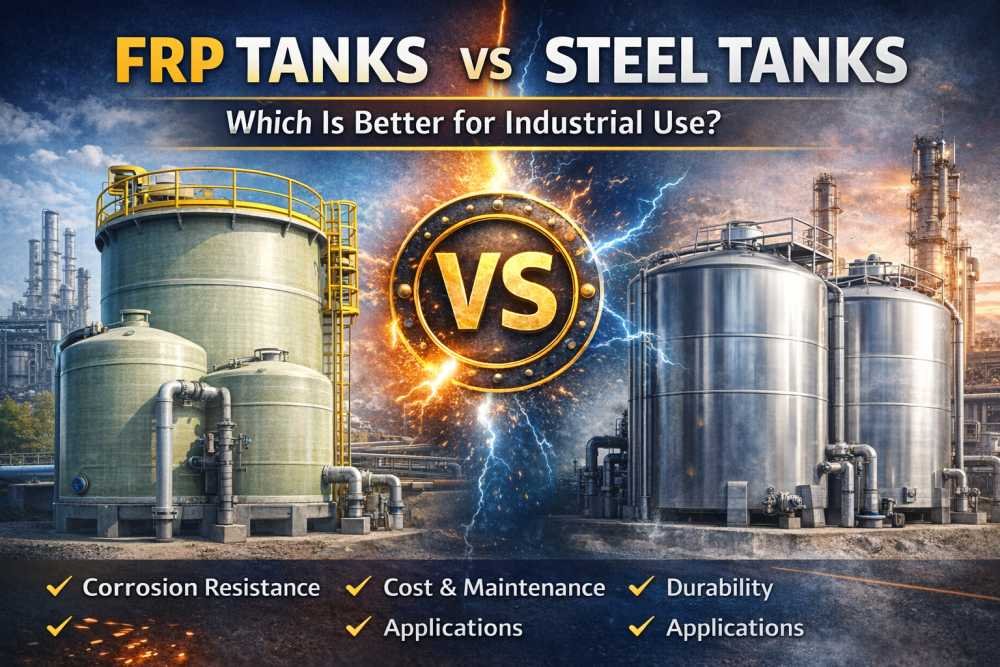
FRP Tanks vs Steel Tanks: Which Is Better for Industrial Use?
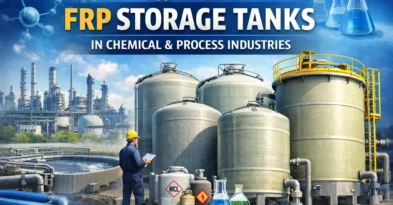
In industrial sectors such as chemical processing, water treatment, pharmaceuticals, power plants, and manufacturing, storage tanks play a critical role in ensuring safe handling, storage, and transportation of liquids and chemicals.
Traditionally, steel tanks have been widely used, but in recent years, FRP (Fiber Reinforced Plastic) tanks have gained strong preference due to their advanced material properties.
So the big question is:
👉 FRP Tanks vs Steel Tanks – which is better for industrial use?
This blog provides a clear comparison to help industries choose the right storage solution based on performance, cost, durability, and application.
What Are FRP Tanks?
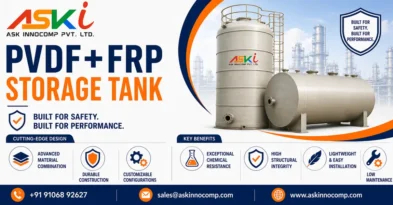
FRP tanks are made from glass fibers reinforced with resins such as polyester, vinyl ester, or epoxy. This composite structure offers exceptional corrosion resistance, high strength, and long service life, especially in aggressive industrial environments.
They are widely used for storing:
- Corrosive chemicals
- Industrial effluents
- Acids and alkalis
- Process liquids
What Are Steel Tanks?
Steel tanks are fabricated using carbon steel, mild steel, or stainless steel. They are known for their high mechanical strength and pressure-handling capability, making them suitable for certain heavy-duty industrial applications.
Steel tanks are commonly used for:
- Fuel storage
- Oil and petroleum products
- High-temperature liquids
- Structural applications
Key Comparison: FRP Tanks vs Steel Tanks
Corrosion Resistance
FRP Tanks:
- Excellent resistance to corrosion
- Ideal for acids, alkalis, salts, and chemicals
- No rusting or scaling
Steel Tanks:
- Highly prone to corrosion
- Require coatings, linings, or cathodic protection
- Regular maintenance needed
✅ Winner: FRP Tanks
Maintenance & Lifecycle Cost
FRP Tanks:
- Minimal maintenance
- No painting or anti-corrosion treatment required
- Long service life (20–30 years)
Steel Tanks:
- Frequent inspection and repainting
- Higher long-term maintenance cost
- Corrosion shortens lifespan
✅ Winner: FRP Tanks
Strength & Structural Performance
FRP Tanks:
- High strength-to-weight ratio
- Suitable for atmospheric and low-pressure applications
- Lightweight construction
Steel Tanks:
- Very high mechanical and impact strength
- Better for high-pressure and structural load conditions
✅ Winner: Steel Tanks (for high-pressure needs)
Weight & Installation
FRP Tanks:
- Lightweight and easy to transport
- Faster installation
- Lower foundation and crane cost
Steel Tanks:
- Heavy and difficult to transport
- Requires heavy lifting equipment
- Higher installation cost
✅ Winner: FRP Tanks
Customization & Design Flexibility
FRP Tanks:
- Highly customizable shapes, sizes, and linings
- Designed based on chemical compatibility
- Easy integration with piping and accessories
Steel Tanks:
- Limited flexibility
- Design changes increase cost significantly
✅ Winner: FRP Tanks
Temperature & Pressure Handling
FRP Tanks:
- Suitable for moderate temperature ranges
- Performance depends on resin selection
Steel Tanks:
- Excellent for very high temperatures and pressures
✅ Winner: Steel Tanks (for extreme conditions)
Comparison Table: FRP Tanks vs Steel Tanks
| Parameter | FRP Tanks | Steel Tanks |
|---|---|---|
| Corrosion Resistance | Excellent | Poor (needs coating) |
| Maintenance Cost | Very Low | High |
| Weight | Lightweight | Heavy |
| Installation | Easy & fast | Complex |
| Customization | High | Limited |
| Service Life | 20–30 Years | Shorter without protection |
| Cost Efficiency | High (long-term) | Moderate to Low |
Industrial Applications
Which Tank Should You Choose?
Choose FRP Tanks If:
- You store corrosive chemicals or effluents
- Low maintenance is a priority
- Long service life is required
- Installation speed and cost matter
Industries:
Chemical plants, ETP/STP, pharma, fertilizers, water treatment, food processing
Choose Steel Tanks If:
- High pressure or high temperature is involved
- Structural load-bearing is required
- Storing fuels or petroleum products
Industries:
Oil & gas, refineries, power plants, heavy engineering
For most chemical and process industries, FRP tanks are the better choice due to their corrosion resistance, low maintenance, long lifespan, and cost-effectiveness.
Steel tanks still remain relevant for high-pressure and extreme temperature applications, but for routine industrial chemical storage, FRP tanks offer superior overall value.
Conclusion
Choosing between FRP tanks and steel tanks depends on your industrial application, chemical nature, temperature, pressure, and long-term cost goals.
With advancements in composite technology, FRP tanks are rapidly becoming the preferred industrial storage solution across India and globally.